The 4 Basic Haircuts Every Man Should Know (Before Your Next Appointment)
Every men’s haircut, from a classic crew cut to a textured pompadour, is built on four fundamental cutting techniques: solid form, graduated form, increase-layered form, and uniform-layered form. Understanding these foundational structures transforms how you communicate with your barber and, critically, helps you spot the difference between a precisely executed cut and a sloppy one. Most men don’t realize that the disappointment they feel walking out of a barbershop often stems from a fundamental form being poorly executed rather than choosing the wrong style.
These four forms determine how hair falls, where weight sits, and how your cut will grow out over the coming weeks. A solid form creates clean, blunt lines and maximum density. Graduated cuts build that tapered shape from your neckline up through the sides. Increase-layered forms remove weight while maintaining length on top. Uniform layers create consistent texture throughout. Every haircut you’ve ever had, whether you knew it or not, relied on at least one of these structures.
Learning to recognize these forms gives you a vocabulary for the barbershop and, more importantly, an eye for quality. You’ll spot when your barber has created clean weight lines versus choppy, uneven sections. You’ll understand why some cuts seem to lose their shape after a week while others maintain structure for a month.
Why These Four Cuts Form the Foundation
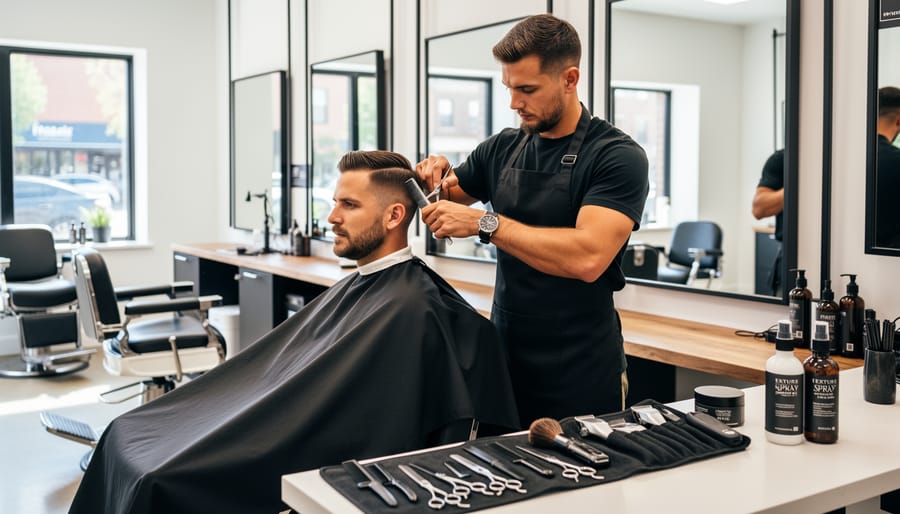
Every haircut your barber creates, whether it’s a classic crew cut, a textured crop, or a modern quiff, is built from just four fundamental cutting structures. These aren’t hairstyle names. They’re the architectural forms that determine how hair sits, moves, and frames your face. Professional barbers and stylists learn these structures during their training because they’re the grammar of haircutting. Once you understand this framework, you can spot when something’s been executed properly and when it hasn’t.
Think of these four cuts as the primary colors of haircutting. Just as every shade of paint derives from red, blue, and yellow, every men’s hairstyle emerges from some combination of these foundational forms. A barber might use a graduated structure on the sides with layering through the top, or blend a solid perimeter with increased layering for movement. The specific mix determines the final style, but the building blocks remain constant.
When you recognize how these structures work, you gain a critical advantage. You can articulate what you want instead of pointing at a photo and hoping for the best. You’ll understand why your barber asks about how much weight you want removed or where you need movement. More importantly, you’ll know when a haircut has gone wrong while you’re still in the chair, not after you’ve paid and left. That’s the difference between leaving the barbershop satisfied and spending two weeks waiting for your hair to grow out.
The Solid Form (One-Length Cut)
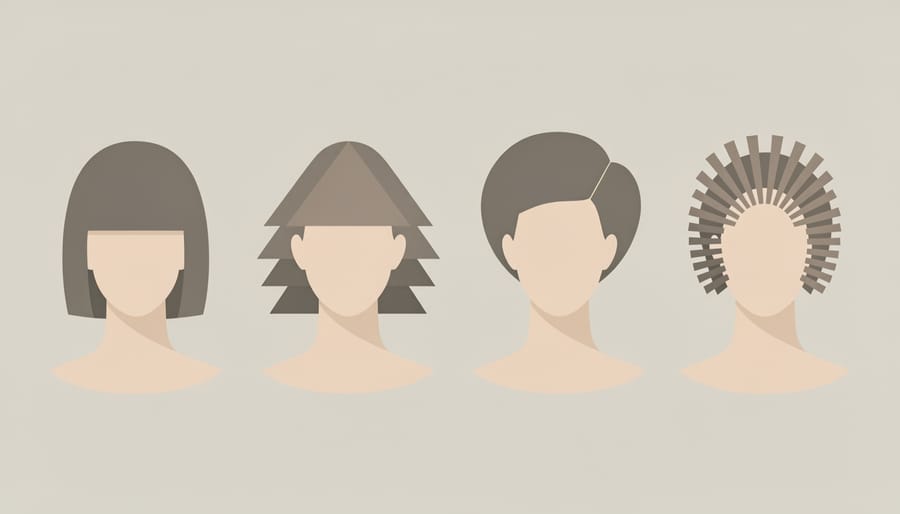
The solid form represents the most straightforward of the four basic haircuts, built on a deceptively simple principle: every strand of hair reaches the same point on the perimeter when combed straight down. Think of it as a blunt cut that creates a defined weight line where all the hair ends at precisely the same length.
This technique works by holding hair at zero degrees of elevation from the scalp and cutting horizontally across. The result is maximum density at the perimeter, creating a clean, geometric shape with substantial visual weight. When executed properly, you’ll see a crisp, even line with no stray hairs breaking the perimeter and no gaps or unevenness when the hair is combed smooth.
The solid form suits men with naturally straight or only slightly wavy hair who want a polished, controlled look. It’s particularly effective for classic bowl cuts, certain fringe styles, and precision geometric shapes. However, it’s less forgiving on curly or highly textured hair, where the blunt perimeter can appear bulky or create an unflattering triangle shape as the hair expands outward.
Common execution mistakes reveal themselves immediately. Look for an uneven perimeter where hair lengths vary, creating a jagged rather than smooth line. Poor sectioning during cutting produces notches or steps in the weight line. If the barber fails to account for your natural hair growth patterns, you’ll notice the perimeter sitting unevenly or certain sections flipping out awkwardly. Another red flag is over-texturizing the ends, which defeats the entire purpose of a solid form by removing the clean weight line that defines this cut.
The solid form serves as the foundation for understanding how hair creates shape through length and density, making it essential knowledge for recognizing quality work.
The Graduated Form (Stacked Cut)
The graduated form, often called a stacked cut, builds weight and volume at the perimeter by cutting hair at progressively shorter lengths as you move from the outside to the inside of the head. Think of it as creating a staircase effect where each layer sits slightly above the previous one, stacking hair into a visible ridge or corner. This technique is the backbone of many classic men’s cuts, from traditional high-and-tight styles to modern textured crops with weight at the top.
- Weight line
- The visible horizontal ridge or corner where graduated layers stack and create concentrated mass. A well-executed weight line appears clean and deliberate, not accidental or uneven.
- Elevation
- The angle at which hair is held away from the head during cutting. Lower elevation (closer to the head) creates more stacking and a stronger weight line in graduated cuts.
- Graduation angle
- The degree of slope between the shortest interior layers and the longest perimeter length. Steeper angles produce more dramatic stacking and visible weight concentration.
This cut flatters men with flatter occipital bones (the back of the skull) because the stacked weight creates the illusion of roundness and projection. It’s also effective for adding volume to fine or thin hair, as the layered stacking makes hair appear fuller at specific zones. The graduated form requires precision, each layer must be cut at the correct angle to build that weight line smoothly.
Poor execution reveals itself quickly. An over-stacked cut creates a helmet-like shelf or hockey-puck appearance where the weight line is too severe and disconnected from the rest of the head shape. You’ll see a harsh ridge that looks bolted on rather than integrated. Uneven graduation shows up as a wobbly or inconsistent weight line that dips and rises instead of following a clean curve. If the layers beneath the weight line are too short or choppy, you’ll notice holes or see-through patches where the hair doesn’t stack properly. The hallmark of quality graduation is a smooth, controlled build of weight that enhances your head shape rather than fighting it.
The Layered Form (Uniform Layers)
The layered form represents the workhorse of modern men’s haircutting, a structure where hair maintains uniform length throughout the head when pulled out at consistent angles. Unlike graduated cuts that build weight at the perimeter, uniform layers create equal length from crown to sides, producing natural movement and built-in texture.
Think of it this way: when a barber cuts uniform layers properly, each section of hair reaches the same distance from the scalp regardless of where it sits on your head. Pull a strand from the crown and one from above your ear, and they’ll measure identically. This consistency generates volume throughout rather than concentrated at any single area.
The technique suits men with medium to thick hair density particularly well. Fine hair often lacks the body to support uniform layers without looking limp, while coarse hair thrives with this approach, the equal lengths prevent bulkiness and encourage natural texture to emerge. The structure works across face shapes because it doesn’t create dramatic lines or severe angles.
Quality execution shows in the transitions. Your layers should blend seamlessly, with no visible steps or disconnections between sections. Run your fingers through your hair after the cut; you shouldn’t feel sudden length changes or shelf-like edges. The movement should appear organic, not engineered.
Poor layering announces itself immediately. Choppy sections where hair suddenly shifts length indicate inconsistent tension or imprecise elevation during cutting. Disconnected areas, where one section clearly separates from another rather than flowing together, suggest rushed work or lack of proper cross-checking. You might notice bulk concentrated in odd spots or patches that stick out independently rather than moving with the rest of your hair.
A skilled barber checks their layering from multiple angles and combs through repeatedly to ensure continuity. The final result should look deliberately textured, not accidentally hacked.
The Increase-Layered Form (Long Layered Cut)
The increase-layered form stands apart from the uniform layered cut by creating a deliberate progression where the shortest hair sits closest to the head, with each successive layer growing longer toward the perimeter. Think of it as the inverse of graduation: instead of weight stacking at the bottom, this structure disperses weight throughout, producing softer, more elongated silhouettes that drape naturally.
This technique works by cutting the interior sections first at shorter lengths, then progressively increasing the length as the stylist moves outward. The result is a cut that maintains fullness and body while avoiding the heavy perimeter line of solid forms or the uniform texture of traditional layers. It’s particularly effective for men growing out their hair or those with finer textures who want movement without sacrificing length.
The increase-layered form suits oval and longer face shapes exceptionally well, as the elongated shape complements natural proportions. Men with thick, wavy hair often find this structure tames bulk while preserving length. It’s the foundation beneath many medium-to-long contemporary styles, from textured quiffs to swept-back looks.
Quality execution shows in the seamless transitions between layers. Run your fingers from scalp to ends, you shouldn’t encounter sudden length jumps or feel distinct separations between sections. The graduation should be so gradual it’s nearly imperceptible to touch. Poor craftsmanship reveals itself through visible horizontal lines where layers begin, creating a terraced effect rather than smooth flow.
Watch for inconsistent length distribution as well. If one side appears noticeably longer or the back doesn’t match the crown’s layering pattern, the barber hasn’t maintained proper technique throughout. The increase should be methodical and symmetrical, not haphazard. A well-executed increase-layered cut moves as one cohesive unit, not as separate sections fighting each other.
How These Cuts Combine in Modern Styles
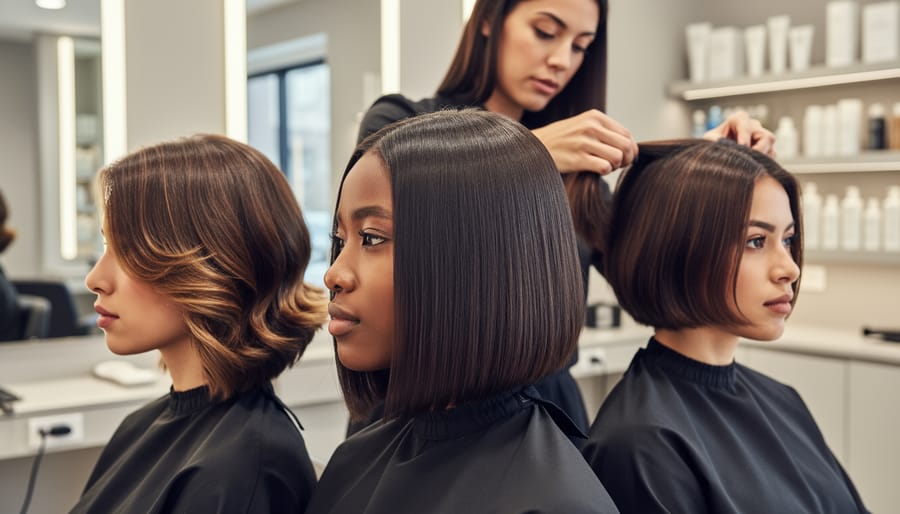
Modern men’s haircuts rarely exist in isolation. Instead, professional barbers combine the four basic haircuts to create the sophisticated styles you see today. Understanding these combinations helps you assess whether your barber has the technical skill to execute contemporary looks properly.
| Style | Forms Combined | Quality Indicator |
|---|---|---|
| Textured Crop | Graduated + Layered | Seamless blend at sides, defined texture on top |
| Modern Pompadour | Graduated + Increase-Layered | Clean weight line, progressive length increase |
| Slicked Back Undercut | Solid + Layered | Sharp disconnect, uniform top length |
| Taper Fade | Graduated (primarily) | Smooth transition, no visible lines |
The textured crop, popular across Y2K fashion for men and contemporary streetwear, pairs graduated sides with layered tops for movement. Watch for choppy transitions where these forms meet. The classic fade employs pure graduation, stacking progressively shorter lengths. Poor execution shows as visible lines or uneven patches.
Many Y2K men’s style revivals feature disconnected undercuts combining solid-form tops with dramatically graduated sides. Quality here means crisp perimeter work and intentional weight placement. If the disconnect looks accidental rather than deliberate, that’s a red flag.
Even trending men’s Y2K looks with shaggy, seemingly effortless texture rely on increase-layered structures underneath. The difference between intentional and sloppy lies in how those layers progress. Skilled barbers create controlled texture; poor ones leave you with random, disconnected pieces.
Understanding these four basic haircuts transforms you from passive client to informed collaborator. When you can articulate whether you want solid weight at the perimeter or graduated stacking, your barber immediately grasps your vision, no more pointing at celebrity photos and hoping for the best. More importantly, you’ll recognize poor execution the moment you see it: choppy layers that don’t blend, excessive weight that distorts your head shape, or graduation that creates unflattering bulk.
This knowledge isn’t about becoming a stylist yourself. It’s about developing the discerning eye that separates a mediocre trim from exceptional craftsmanship. Just as understanding how Y2K works helps you navigate contemporary fashion trends, knowing these foundational structures helps you navigate the barber’s chair with confidence.
The well-groomed man doesn’t leave his appearance to chance or unclear communication. He understands the fundamentals, spots quality work, and walks out knowing exactly what he’s received. That’s the difference between getting a haircut and getting the right haircut.